
Metroid Prime 4: Beyond: Eighteen Years for This
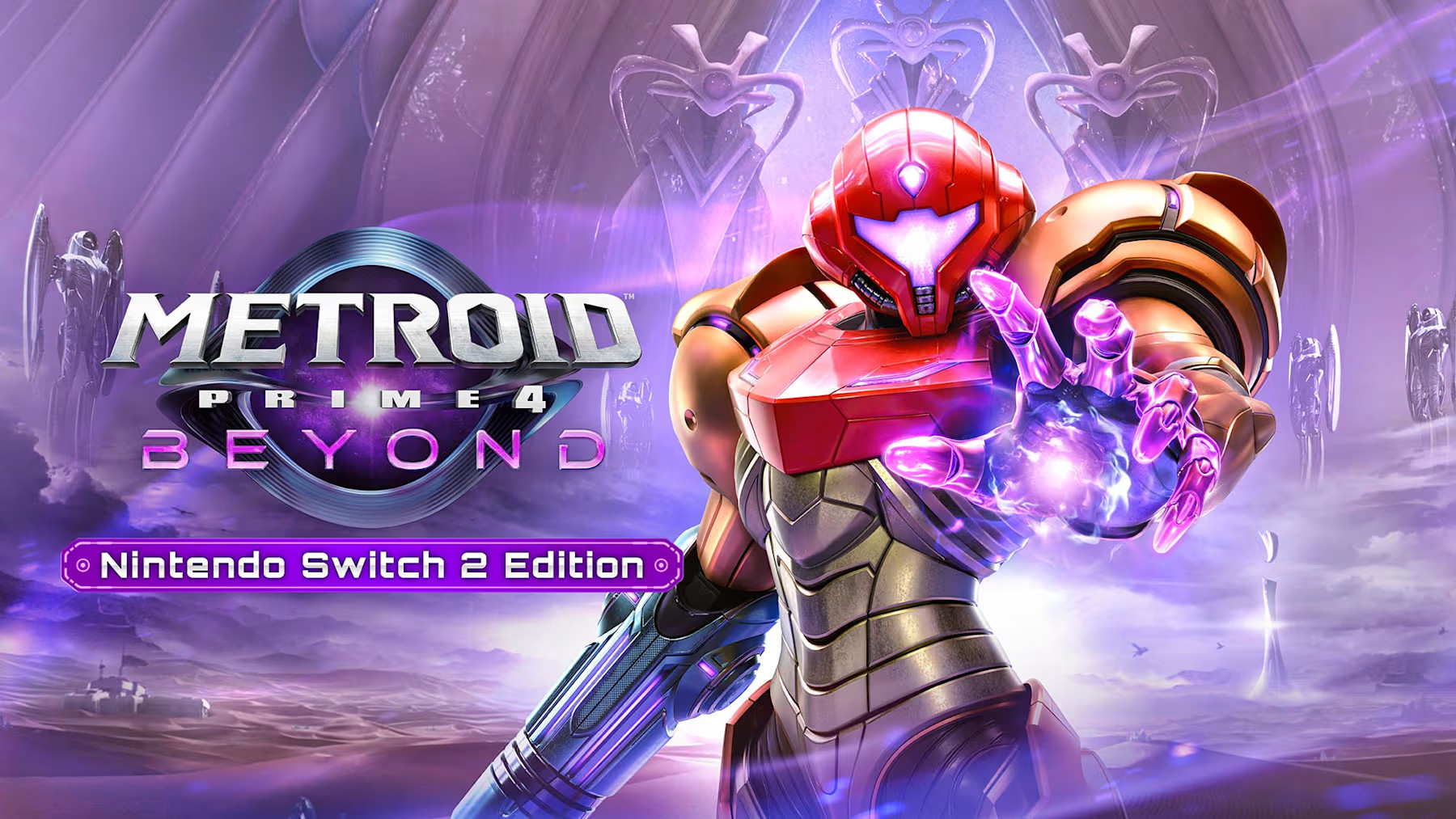
Eighteen years.
I bought Metroid Prime 3: Corruption out of curiosity, more or less at random, without really knowing what I was getting into. And I fell in love with it. Since then, I've caught up with the entire series. I've waited for this fourth instalment the way you wait for something you've stopped believing will ever actually arrive. And then it came out. December 4th, 2025. On Switch and Switch 2.
So here we are. I played it. And I have things to say.
What works: it's a Metroid Prime
Let's start with the good, because there is some.
Viewros, the planet where the adventure unfolds, is beautiful. Dense, coherent, oppressive in just the right measure. The atmosphere is intact: you feel alone, vulnerable, an explorer. Retro Studios hasn't forgotten what makes this series tick.
On Switch 2, it looks stunning. Genuinely. I bought the Switch 2 for it, actually — for Beyond and for Donkey Kong Bananza. Confirmed Nintendo fanboy, premium-tier pigeon. (I almost regretted it) At least it looks good. What comes next? We'll see. In the meantime, Viewros is gorgeous and the environments outside the Sol Valley have a real visual identity.
The bosses are generally well-designed: some genuinely memorable, others more forgettable. Mixed, then. Let's say the best moments are very good, and the average drags them down a bit.
Samus's psychic powers, on the other hand, left me puzzled. The basic concept is interesting: you guide your shots telekinetically, time slows down, it looks spectacular. Except "psychic" in this context is just sugar coating on Lamorn technological magic. A Nintendo short on inspiration simply rebranded its usual gadgets with a word that sounds mysterious. (the psychic beam could have been called a "quantum nano-wave super-beam" and the effect would have been identical)
There's one genuinely unexpected bright spot: the Vi-O-La. This neurological motorbike inherited from the Lamorn civilisation, which you build yourself in a reactivated factory in one of the game's best sequences, has character. The concept is original, its integration into the lore is solid, and riding it is enjoyable.
Except it's mostly used to cross the Sol Valley. A desert zone that's 90% empty. This central area it's supposed to bring to life is mainly a sand corridor between the actual game zones. The Vi-O-La deserved better than a wasteland. (and the Joy-Con 2 in mouse mode, while we're at it: not convinced either. The idea is there; the practice is less obvious)
But.
The story: as flat as the Sol Valley
Let's start at the beginning. The intro: mysterious artefact at the GF, Space Pirates attack, the mysterious Sylux leads the assault, a firefight, bam, teleported to an unknown planet. To get home, you need to activate a teleporter that appears out of nowhere by collecting five keys scattered across said planet. That's your premise.
Along the way: flashbacks to Federation Marine battles. Visions. Mystery. Very mysterious. (dun dun duuun)
The bosses? Lamorn guardians fused with Metroids. And when the game presents Sylux in combat, it's always a Psy-bot, a robot in his image. Because the real Sylux is lounging in a psychic regeneration pod for the entire duration of the game. He's the great villain announced since Metroid Prime Hunters, awaited for years, and he spends most of Beyond napping in a pod.
He shows up properly in the last ten minutes. And there he is... edgy. Very edgy. The kind of villain who emerges with dramatic music, a dark design, a threatening line, and zero character development.
And yet, on paper, his plan is ambitious. Sylux has captured Metroids. He's discovered that by mutating them, he can control people's minds. WHOUHOUHOUHOU. That's enormous. That's the kind of revelation that should recontextualise everything we've been through, give the villain a terrifying dimension, explain why he's an existential threat.
Except the game never asks the questions that naturally follow. How did he discover this? Why does he want revenge on the Galactic Federation and on Samus? How did he acquire this mastery of Metroids and Lamorn psyche? The game's implicit answer to all these questions is the same: because he's the villain. Isn't that enough?
Apparently yes. The impression it leaves: "we need a villain, Sylux is the villain, he has a wild plan, dun dun duuun, fight, credits." Eighteen years of waiting for this.
And then there are the Lamorn. Oh, the Lamorn.
A civilisation that mastered near-divine technologies: psychic, energetic, temporal. People who built autonomous factories, intergalactic teleporters, neural motorbikes. And their great survival plan was to wait for a bounty hunter who happened to land on their planet to "carry their legacy to the stars". Why her? Because of the Prophecy. (of course)
Except the Lamorn accidentally transformed themselves into Grievers, by flooding their planet with Green Energy to regenerate it — which mutated their own biology. So the great divine civilisation botched its ecological project and destroyed itself. And their response to that was to build prophetic devices to wait for a chosen one.
There's something interesting in there, in passing. Green Energy as a miracle resource that turns on those who exploit it: it's an ecological metaphor that holds up. An industrial civilisation that over-exploits its planet, believes it can repair the damage using the same extractivist logic, and destroys itself in the process. That's not stupid. That's potentially very good, actually.
Except the game doesn't follow the thread. Green Energy remains functionally a new Phazon: a green substance that corrupts, serves as a MacGuffin, gets collected as crystals. The parallel with the previous Primes is so obvious that multiple analyses flagged it immediately. Either it's a deliberate homage or it's a lack of imagination. The game doesn't say which option it's going for, and that's a shame: the ecological reading would have given real thematic backbone to a story that badly needs one.
The problem: Samus spends the game massacring Grievers by the hundreds. Grievers who are, let's remember, former mutated Lamorn. She's killing off the civilisation she's supposed to be saving. The game acknowledges this, to its credit: there is a moment where someone says this is terrible. And then we move on. (moral caution validated, carry on shooting Lamorn)
The crystal grind: four hours of my life
There's a moment in the game where you're asked to collect crystals scattered across the central zone: the Sol Valley, a desert area connecting the main play zones.
On paper: classic Metroid exploration.
In practice: four hours of my life I will never get back.
The problem is simple and unforgivable: the tracker doesn't update in real time. You pick up crystals; the interface doesn't update instantly. No way to know precisely what's missing at any given moment. Result: you go back to zones you've already cleared, you go round in circles, you search for what you have or haven't collected. (in a game where exploration is supposed to be rewarded by logic, this is a fairly enormous betrayal of concept)
A Metroid rewards observation and deduction. It doesn't punish players with broken tracking tools. This is blind collection dressed up as exploration. The distinction matters.
The auto-aim that turns against you
The aim assist is useful most of the time. And then there are certain fights where it locks onto the wrong enemy, misses the critical hitbox, breaks the rhythm of a boss fight that's supposed to be tense.
It's not a dealbreaker. You can tinker with the options to reduce it. But having to adjust your settings mid-game because the auto-aim was miscalibrated for specific cases is a lack of polish that shows. (especially for a game eighteen years in the making)
The NPCs: uninvited guests who won't leave
Metroid Prime is a game of solitude. Samus against the world, the unknown, the silence. That's one of the reasons the series works.
Beyond decided to add a team of Galactic Federation soldiers. And it goes sideways from there.
Myles MacKenzie, the technician, is the most complex case. He calls you on the radio every three minutes. Literally. "You know, Samus, if you've got crystals, you should bring them back, yeah?" "You know, if you get lost, you can call me?" At some point you almost expect "You know, Samus, remember to use your lungs to breathe, yeah? Organisms need oxygen at the biological level." ugh.
Outside the radio, he's a Gary Stu. He understands alien technology, he builds weapons for Samus, he always has the solution. (a Galactic Federation technician who instantly deciphers a vanished civilisation. Obviously. Though, to be fair, Samus did receive a magic crystal — sorry, a psychic chip — that gives her powers and a connection to the planet, so technically there's a justification. Technically.) The worst part: you have to go see him for every upgrade. Every. Single. Upgrade. He's the mandatory checkpoint, the hub NPC you walk past sighing to unlock what you just earned.
That said, and this is where honesty kicks in, I can't quite bring myself to hate him, much as I'd like to. MacKenzie is the nice guy who tries too hard. He's sincere. He makes an effort. He even manages to redeem himself at moments. I don't like him that much, but I'd like him to be okay. Which is probably the bare minimum you can ask of a character. (which, at the end of the day, might be the real problem: he deserves to be ignored, but he's too likeable for that)
Sergeant Ezra Duke and recruit Nora Armstrong are just... forgettable. Duke does the sergeant thing, Armstrong does the recruit-awed-by-Samus thing. Functional. Interchangeable. You meet them, you forget them. A far cry from Admiral Castor Dane in Corruption, or the Task Force Herakles Marines in Echoes, whose final moments you discovered through log entries and who had more presence dead than Duke and Armstrong have alive. But at least they're not the disasters from Other M. (the reference bar is right there, and it is low)
A word on Samus herself, while we're at it. In Other M, she narrated everything in voiceover, fainted at the sight of Ridley, had a breakdown every three metres. The backlash from Other M clearly traumatised Nintendo, because in Beyond, Samus says absolutely nothing. Zero. Rigid psychopath in a suit. It's not better — it's just the opposite extreme. Dread had found the right balance: give her a few words in Chozo, understated, loaded with meaning. (Dread. Dread understood.) Here, we oscillate between the traumatised chatty Samus and the stone-wall Samus. There's surely a middle ground.
And then there are the two who save the day.
Reger Tokabi and VUE-995 are my joint favourites, for opposite but complementary reasons. Tokabi is laconic, discreet, he fits into the story without parasitising it. He's also presented as a believer, guided by faith in his survival, which could have been interesting — except it stays as a cardboard line dropped in without development. Parachuted lore, again. VUE-995, the combat robot, doesn't discuss, doesn't give advice, doesn't call you every three minutes to explain how breathing works. It's effective. And paradoxically, it's the character you end up most attached to, precisely because it doesn't try to be noticed. (the lesson might just be this: the less you do, the more you land)
Except the real problem with this whole team is the final boss fight. Part of its difficulty — and its confusion — comes directly from them. Duke and Armstrong screaming "I got hit, help, I'm going to die" while you're trying to concentrate. And MacKenzie. MacKenzie who is there. In the middle of the fight. Him. The support technician. What is he doing there? Did nobody tell him to stay at base?
The answer is that Sylux has built an arena nobody can escape, because that's the story and he's the villain. Everyone ends up trapped in the same place, enduring the final fight together, whether they're a seasoned soldier or a technician with glasses. Convenient for the narrative. A nightmare to play.
Their presence creates additional variables that complicate the fight without enriching it. The first part of the battle is mind-numbingly boring.
Fortunately, and this is where the game redeems itself, magic intervenes. Sorry: techno-fiction science. A psycho-psychic-magic-spatio-temporal wormhole swallows Sylux and Samus, and we end up in a duel. Samus versus Sylux. One on one. Without MacKenzie underfoot. And that? That's good. Really good. The kind of fight that deserved to come sooner, built around an antagonist we deserved to know better. (thank you, Samus's new friends)
A reasonable ending, but not a brave one
I'll stay vague about spoilers. But it needs to be discussed.
Samus is a character of solitude. Of cold discipline. She expects nothing, asks for nothing, moves forward. That's what's made her an iconic character for decades.
The ending of Beyond betrays that on two levels. First, it's an open ending — which, in itself, is fine, if it's handled well. Except that her team sacrifices themselves before her eyes, and Samus leaves. Gone. Credits. No resolution, no weight, no moment that lands. For a character supposed to have carried the world alone for decades, the direction is disconcertingly light.
It's off-lore. Not catastrophic, but not brave either. (I'd have preferred a divisive ending to one that waits for a sequel to exist)
So?
Beyond is a game I picked up and put down three times before finishing it. Three times. Put down, picked up, put down, picked up. 17 hours on the clock. 13 hours, maybe less, if Nintendo had sorted its crystal tracking. Four hours lost wandering in sand: it shows, you feel it, it sticks.
From the eighth hour onwards, I just wanted it to be over. Not because it was bad. Because I couldn't take any more of waiting for the game to live up to what it promised. If this had been any other series, I'd have dropped it there and never thought about it again. It's a Metroid, so I kept going. That's not quite a compliment.
But it accumulates frustrations that should never have survived development. A flat story with a civilisation whose internal logic doesn't hold, a villain in pyjamas for 90% of the game who shows up in the last ten minutes acting edgy. The crystal grind with broken tracking. The capricious auto-aim. MacKenzie calling every three minutes. NPCs who parasitise the final fight. An ending without courage. The Vi-O-La wasted on an empty planet.
I'm giving it 6.25/10. Generous.
(My autocorrect tried to replace "Metroid Prime 4" with "Metroid Grime 4". Not far off.)
Phil R. Fell into the series by accident with Corruption on the Wii, and never entirely climbed back out.