
Nineteen and a half hours for two fingers per hand (what is the ulnar nerve?)
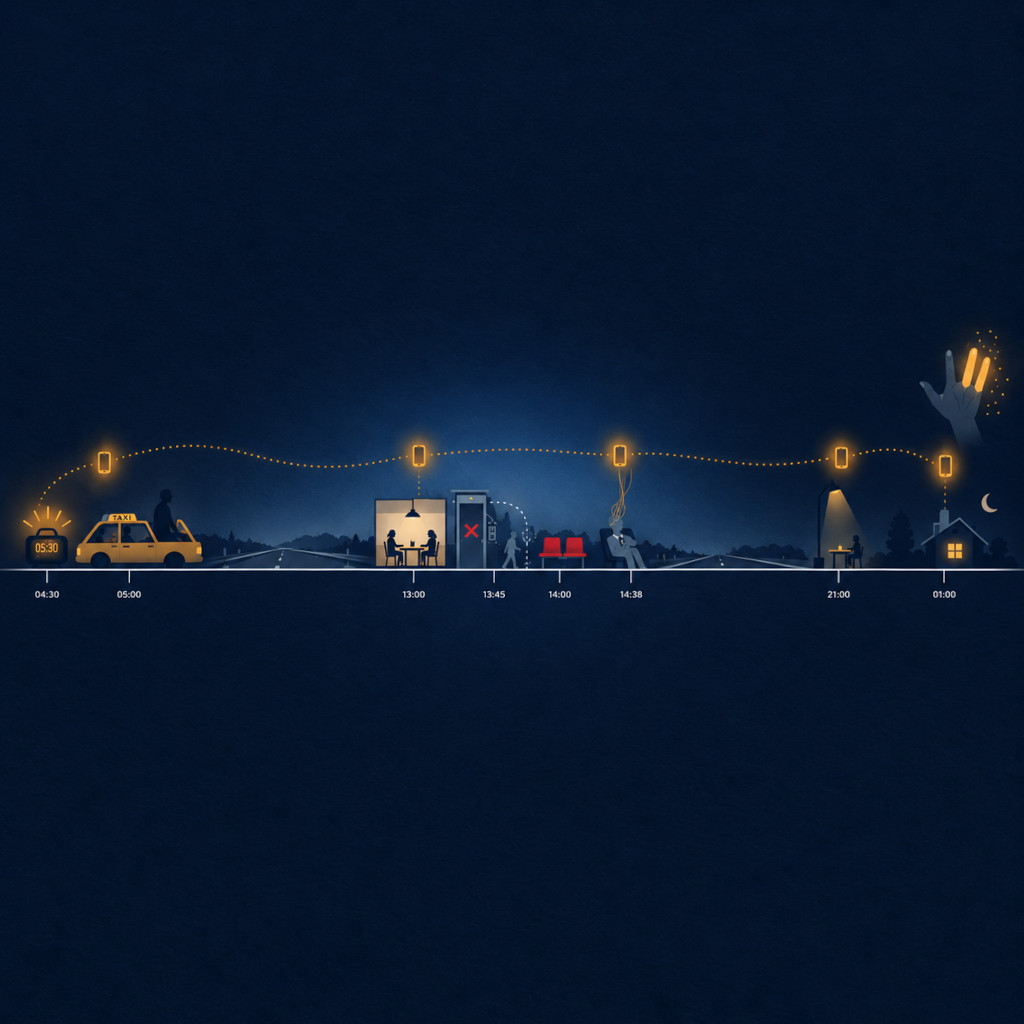
The previous post was called "Almost Eighteen Months". It was calm, it took stock, and it announced a wedding in June.
Things have happened since. I got married in June. Honeymoon in July. Back in France in August. And on 9 September, I went back up to the Pitié for a programming session.
This post is the story of that day. Fair warning: it doesn't look like the previous ones. No puppet, no Haddock night, no three in the morning. It's a programming day that went well. I think that deserves to be written down too. We always tell the bad days because they make better stories, but it's the good days that say the most about where you actually are.
Five thirty
The alarm goes off at five thirty. Not four. An extra hour and a half of sleep, and above all: no airport.
That's the change this time, and it changes everything. The trip was done by medical taxi, door to door. Six hours of road up to Paris. On paper, that's longer than a Rodez-Orly flight. In practice, it's incomparably cheaper for the brain. No check-in, no security gate, no seat where my knees hit the back of the one in front, no staff pulling a face when I ask for the emergency exit row, no flight I mustn't miss, no endless wait in a terminal at five in the afternoon once the adrenaline has drained away.
There's a specific reason we switched to this way of travelling. I'll explain it one day, in another post. For now, just take this away: removing the airport from a programming day removes half the fatigue. Half. That isn't a figure of speech.
I get in the back, I settle in, and there is nothing left for me to handle for six hours. Somewhere on the road, first phone call to Rose Marie.
The Saint Marcel
We reach Paris early, as always, because we only come up for this and it's better to wait outside the hospital than anywhere else.
The restaurant is the Saint Marcel, right across from the Pitié. I'd already mentioned it without naming it, so let's name it now: the owner is from the Aveyron, the staff are lovely, and they've worked out why we keep coming back. They don't ask questions and they don't pretend not to know. That day it was bœuf bourguignon. A good one.
That isn't a food note. Eating properly before a programming session is fuel for the hours that follow, and it's also half an hour of talking about something else. A piece of ordinary life parked right in front of the hospital door.
One forty-five
We reach the hospital at one forty-five. Second phone call to Rose Marie.
I know the route through those corridors by heart. Babinski building, lift, first floor, the one that comes after RH, RB and Mezzanine, and at the end the red leather armchairs of the waiting area. I could do it with my eyes shut.
Except the lift is still out of order. Back in February I wrote that the button had been broken for three months and that nobody was fixing it. It is September now. I withdraw the "nobody is fixing it": at this stage it isn't neglect, it's consistency.
So, small detour. We take the lift of the cardiovascular and cerebral department, go up to the first floor, and from there we have to reach the waiting area from an arrival point that isn't the right one. Which means getting lost. We get lost. We eventually stumble back onto the red armchairs. And on the way out, same performance in reverse: getting lost trying to find the cardio lift from the waiting area. Twice astray in a building I know by heart, because of a lift button.
And then there are the nurses' stations. Some of them are still faithful to the hospital everyone pictures: noise, people telling each other their life stories, nobody listening to the patients, and above all, above all, no silence. Heaven forbid anyone show the patients some respect.
We sit down on the red armchairs, we wait, we watch other people waiting.
Two thirty
The appointment starts at two thirty. The actual programming starts at two thirty-eight. Eight minutes apart, and those eight minutes count: they're the time it takes to say hello, to tell her about the summer, the wedding, the trip, to answer the usual questions. Then the remote goes onto the implant, and only then does the current move.
There's a stinging in the eyes. That's the first sensation, immediate, as soon as the current goes up: a prickle behind the eyeballs, like too much screen time in the dark, except nobody turned on a screen. Then the lip muscle tightens, on one side only, and my sentence falls apart. What I meant to say was "I'm doing fine". What came out was:
ipf dpoing fprne
In February, that kind of moment used to last. That was the worst of it, in fact: the sensation didn't pass, it hung there as long as the current was spilling over, and I became the puppet. This time it clears in five minutes. Five minutes, and the lip relaxes, and the eyes stop stinging, and I can say "I'm doing fine" again with all the letters where they belong.
Five minutes against a whole afternoon. I don't know whether it's the settings, the target, the brain getting used to it, or all three, but it's measurable, and it's enormous.
Third phone call to Rose Marie.
Three o'clock
Out at three. Thirty minutes of appointment, walking test included. Twenty-two if you count from the moment the current moved.
Fourth phone call to Rose Marie. By this point you must be wondering what there is left to say every forty minutes. The answer: not much. That's the whole point. It isn't a medical report, it's a voice. I say where I'm at, she says what she's doing, we hang up, and the day carries on one notch lighter. The first post I wrote about her was simply called "Rose Marie". Since June she's my wife, and she still picks up.
We leave at three forty. Six hours of road the other way.
The orthodontist
There's something I had never put into words before that drive, and it hit me somewhere on the motorway: I've lived this day before. A very long time ago, and for my teeth.
When I was young I wore braces. The orthodontist was in Albi. We lived in Rieupeyroux. Two hours of road, because we always left early and always arrived early. Two hours for a five-minute appointment: tighten a wire, change an elastic, check two or three things, done. Then two hours back. And afterwards, for several days, it hurt. The jaw pulling, the teeth protesting against the fraction of a millimetre they'd just been moved.
It's exactly the same structure. Long trip, short adjustment, long trip, and the pain arriving afterwards, once everyone is home and the appointment is already far away.
Obviously it isn't the same scale. Braces aren't a neurostimulator, and a tightened wire isn't an electrode contact in the pallidum. But the rhythm is identical, and so is the logic: something gets moved by a tiny notch, the body disagrees, and it needs days to come round. The price is never paid on site. It's paid afterwards, at home, far from the consulting room.
I find that almost reassuring. It means I've known how to do this since I was small. It isn't a new experience, it's an old acquaintance that has changed scale.
Five o'clock
First stop at five. Assessment: still no abnormal side effects. Just mild fatigue.
Mild fatigue. Reread the February post and measure the gap. At five that day, I was asleep on a terminal armchair, cheek against the fake leather, bag still on my shoulder. This time I'm tired the way you're tired after a long drive, not hollowed out the way you are after a day spent absorbing an airport, a plane, a waiting room and a brain that has just been reprogrammed.
Less stress to handle, less debt to pay in the evening. There's nothing mysterious about it. The expensive part of those days was never the current, it was everything around it.
Nine o'clock, Limoges
Second stop at nine in the evening, near Limoges, to eat. Still no strange effects. And a good andouillette.
Again, that isn't a gourmet's note. Six hours after a session, being able to stop, sit down in a roadside restaurant, feel hungry and enjoy the food is an indicator. There have been programming evenings when I couldn't have swallowed a thing, when the very idea of a hot meal would have been beyond me. That evening: andouillette. The body is keeping up.
One in the morning
Home around one in the morning. Fifth and last phone call to Rose Marie. Then sleep.
Nineteen and a half hours of day, from five thirty to one in the morning, for thirty minutes of appointment. The ratio is as absurd as ever, and as necessary as ever. Only this time, I get to the end of it without being in pieces.
PS: what is the ulnar nerve?
There we go, I've found today's side effect: pins and needles in the little fingers and ring fingers. Both hands. Plus the mild diffuse spinning, that one's routine, it's part of the furniture.
Wonderful.
That's how it works. You come home thinking it went well, and the brain waits until the next day to send its invoice, always in a form you didn't see coming. Two fingers per hand. Not the others. So I went looking.
The ulnar nerve is the one everybody knows without knowing it. It starts at the neck, runs down the arm and passes along the inner side of the elbow, just under the skin, in a little bony groove. It's the one you hit when you bang your elbow and get that unpleasant electric jolt all the way to your fingertips. The funny bone, which is only funny for the person watching.
And its territory in the hand is exactly this: the little finger, and half the ring finger, the half facing the little finger. Not the thumb, not the index, not the middle finger, those belong to other nerves. In other words, what is tingling isn't "my hand". It's a precise territory, and that territory has a name.
Which leaves the question of what is pressing on it, and there I have no way of deciding. First hypothesis, mechanical: twelve hours in a car that day, elbows bent, an armrest under the arm, and the nerve compressed as it passes the elbow. It happens to everyone, and it has nothing to do with the brain or the electrodes. Second hypothesis, central: the new settings producing these sensations much higher up, a long way from any elbow.
What tips me towards the first one is the symmetry. Both hands, the same, at the same time. The current tends to work one side at a time.
But I'm not a neurologist. I'm the sensor. My job is to note precisely what I feel and where, not to invent an explanation, and to take all of it to the next appointment. A patient who describes well is worth more than a patient who diagnoses badly.
Nothing alarming, nothing that stops me living. Just the reminder that a programming session always costs something, and that you never know in advance which currency you'll be paying in.
Right. Nothing to do now but wait. Six to eight days, going by the average I've ended up working out. And then we'll know what this one is really worth.