
Eighteen and a half hours for a grimacing puppet
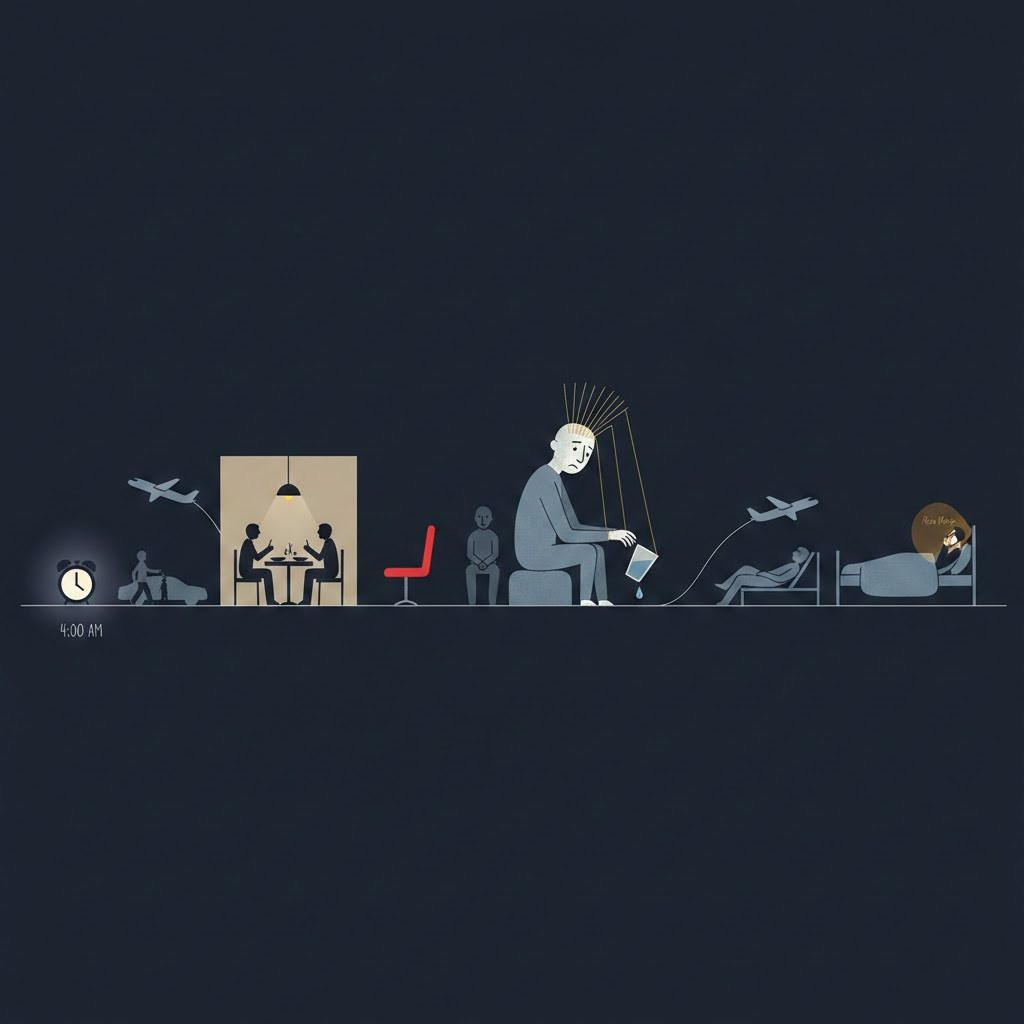
Eighteen and a half hours for a grimacing puppet
I'm writing this post the next day. It's late morning, I've slept thirteen hours straight, and I feel slightly less exhausted than last night. Just enough to understand that what I'm feeling right now isn't tiredness. It's something else. It's the brain digesting what was done to it yesterday, and letting me know in its own way, through sensations I'm beginning to recognise without ever quite getting used to them.
Yesterday was an adjustment day. Eighteen and a half hours, from four in the morning to half past ten at night, for roughly twenty minutes of actual consultation. That's the ratio of this life, and it's absurd, and it's necessary.
Four o'clock
The alarm goes off in the dark. Mum is already up. You don't talk much at four in the morning when you know what's coming, because there's nothing to say that hasn't already been said, and the silence of the small hours has something more honest about it than words. She drives to Rodez airport in the darkness of the Aveyron, headlights piercing the night, and I watch the road go by thinking about that glass of water I still can't drink from.
It's my barometer. Since the operation, for a year now, I measure my progress by this: can I lift a glass of water to my lips and drink without spilling half of it? The answer is no. It's been no since the beginning, it's been no since December, it's no this morning, and that's why we're up at four and taking a plane at six twenty to go looking at the Pitié-Salpêtrière for the tenth of a milliamp or the electrode contact that might change something.
Takeoff. The plane is a small aircraft from a low-cost airline that starts with V and whose name I'll withhold out of charity. I'm two metres seven. The emergency exit row — I'm the one who asks for it on every flight, because in a normal seat my knees touch the back of the seat in front and adding physical discomfort to everything else is beyond me. The staff often pull a face. Some have already made inappropriate remarks and behaved stupidly towards my parents. Let's not credit them with Machiavellian intelligence. It's stupidity, and stupidity needs no explanation. You're tall, you're exhausted, you just want to switch off and sleep, and even that, on a plane, is hard when you're this height and the myoclonias remind you of their existence at the worst possible moment.
Arrival at Orly just before eight. Taxi. Paris. I try to sleep in the back, but no luck. I know the route by heart now, every motorway slip road, every sequence of traffic lights. I don't dread it any more. Maybe that's a sign that something has changed, or maybe fatigue has replaced anxiety, which isn't necessarily progress.
The restaurant
We arrive far too early. The appointment is at one. We have five hours to kill in Paris, and we only come up for this, solely for this, so there's nothing else to do but wait.
There's a restaurant right in front of the hospital. The owner is from the Aveyron too. He knows why we're here. When we push open the door, it's a warm "Ah, you're back" from someone who's understood the situation and doesn't ask questions. He's efficient, because he's understood we're here to eat, not to linger, and that there's an appointment after. I have the Aveyron pork with morel sauce. Mum has mash, no meat. We eat. Aveyron gastronomy in Paris is a piece of home transplanted somewhere that isn't, and it soothes a little, for the length of a meal, before what comes next.
We don't talk about the adjustment. We don't talk about much, actually. It's a real silence, not an awkward one, not a quarrel's silence. The silence of two people who know what's ahead and don't need to put it into words.
The waiting room
I know the Pitié-Salpêtrière by heart. The smell of the corridors, the red seats in the waiting room, the lift button on the first floor that's been broken for three months now and that nobody repairs, the faces of staff you keep crossing and end up recognising. It's an immense hospital, one of the largest in Europe, and I only know a tiny corner of it, always the same one, the one that leads to Pr Karachi's office.
While waiting, I bump into Pauline, the nurse who looked after me during my hospitalisation and convalescence, right after the operation. We cross paths in the corridor, with luck, but it happens every time. There's also Sihame, Pr Karachi's secretary, always kind, always efficient. These small constants are what make the place a little less clinical — faces you recognise and that recognise you back.
And then there are the other patients. Two friendly grandmothers, here for essential tremor. We chat. I smile at them, I make them smile, I try to reassure them as best I can, because I remember very well what it feels like to sit on those red seats waiting to be called, and sometimes a smile from someone who's been through it is worth more than all the brochures in the world.
The programming room
The programming room is Pr Karachi's office. No white room, no monitors lining the walls, no science fiction. A desk, a chair, a computer connected to a programming unit placed on the skin above the neurostimulator, and a conversation between a surgeon and a patient trying together to find the setting that will hold. Mum is there too, seated, silent.
Since December, nothing has shifted. The myoclonias are stable, no better, no worse, and the glass of water remains impossible. We've reached a sort of plateau, and the plateau isn't satisfactory. So Karachi decides to change the active contact on the electrode. Until now, we'd been working with a balance between contact 1 and contact 2 — two different points on the electrode that stimulate slightly different zones of the GPi, the small deep nucleus in the brain that is the target of this whole affair. Today, we go full contact 1. We abandon the compromise to go looking for something else, a little further, a little more precise, a little riskier too, because every time you change configuration, you don't know what you'll find.
We've done this kind of manoeuvre before, once or twice. Every time it's the same ritual: she modifies a parameter, we wait a few seconds, and I describe what's happening.
The puppet
A few seconds is all it takes to know whether a setting works or not. And when it doesn't work, you know because the body does things it wasn't asked to do.
The GPi, the stimulation target, is a tiny nucleus buried in the depths of the brain, and right next to it runs the internal capsule, a broad bundle of white matter containing, among other things, the corticobulbar fibres — the ones that control the muscles of the face, the tongue, speech. When the current is well calibrated, it stays in the GPi and does its job. When it spills over, even slightly, it activates those neighbouring fibres, and that's when it starts.
My tongue starts moving on its own. The muscles in my face contract, twist, pull in directions I didn't choose. I grimace as if someone were remote-controlling me from the inside. I can't speak any more, because my tongue no longer obeys me. It's not painful — I need to say that — it's not physical suffering. But it's deeply, viscerally unpleasant, and above all it's maddening. Imagine an intense wave of fatigue, the kind where stars rise to your head, where your vision spins, where your whole body tells you something needs to pass. Except it doesn't pass. It lasts. It stays there, suspended, for as long as the current spills over. As if someone were pulling the muscles of my face from inside my skull. As if I were a human puppet and someone were testing the wires one by one to see which one makes what move.
And then we adjust, correct, try something else. And with each new configuration, I have to get up, leave the office, walk for about thirty minutes through the corridors of the Pitié or outside along the Boulevard de l'Hôpital, to check the setting's effect in real conditions: walking, hands, speech, balance, everything. Except it's complicated, because after the journey, the four a.m. wake-up, the fatigue, the nerves, I never quite know whether what I'm feeling is the setting or the rest. The measuring instrument is me, and the instrument is tired.
Mum's eyes
Mum is there. She's always there. She's the one who drove at four in the morning, the one who ate her mash in silence opposite the hospital, the one who waited on the red seats, the one who follows me through the corridors when I walk to check a setting, the one who'll still be there tonight on the return flight.
She watches me grimace and says nothing. She sees me struggle to articulate a word while my tongue does as it pleases, and she says nothing. She sees me become a puppet for the duration of a test, and she says nothing, because there's nothing to say. It's not silence by choice; it's silence by powerlessness. She can't do anything. Nothing at all. Just watch, just wait for it to pass, just be there and bear watching her son being manipulated from the inside by an electric current while someone opposite searches for the right parameter.
Her eyes say everything her mouth doesn't. The sadness. The suppressed revolt. The fierce, powerless love of a mother who'd give anything to take your place and knows she can't. And I know, I know it with absolute certainty, that it's worse for her than for me. I'm the puppet, and it's unpleasant, but it's my body, it's my battle, I'm the one who said yes to this operation and who's sitting in that chair. She's a spectator. She's watching a fight she can't wage, against an enemy she can't touch, in a domain she doesn't control. And I don't like imposing this on her. I don't like my disease being hers too.
And for my part — this is the strangest thing — I feel very surrounded and very alone at the same time. Surrounded because she's there, because Karachi is there. Alone because nobody, ever, will be able to feel what I feel the moment the current passes. Nobody can be the puppet in my place. It's an irreducible solitude, the solitude of the body, and no presence in the world can fill it. Only soften it.
Mum is always there. Dad too. They've always been there, for thirty-six years, since the diagnosis, since childhood, since the first tremors, since the operation, since the adjustments. Sometimes I wonder if it's this fight that keeps them young. Whether there's something in fighting for someone you love that stops time from doing its work. And sometimes I wonder something else, something sadder: if one day I'm relieved — not cured, because you don't cure a DYT11, the electrodes are a way of avoiding the symptoms, not erasing them — will they finally be able to retire from supporting me? Will we have peace, the three of us? Or will there be more trouble, because there's always more trouble?
Rose Marie assures me there won't be. And she's used to natural disasters, so I trust her.
The sweet spot
What we're looking for is the sweet spot. The exact point where the stimulation does its job — reducing the dystonia and calming the myoclonias — without spilling over into neighbouring structures, without activating fibres that didn't ask for anything, without turning the patient into a puppet. That point exists somewhere in the complex geometry of my brain, somewhere between contact 1 and contact 2, somewhere between 2 and 3 milliamps, somewhere in the infinitesimal space that separates benefit from side effect. You just have to find it. And to find it, you have to accept going through every configuration that doesn't work.
Karachi listens, observes, adjusts. And before I leave, she says this sentence that matters: "You won't go home with impossible side effects." It's not a detail. It's a commitment. It's someone telling you that you won't be abandoned with a setting that makes your life unliveable, that you can board the return flight knowing you haven't been left in a worse state than the one you arrived in.
Contact 1, full. That's today's choice. But we won't know if it's the right one for at least two months, because DYT11 myoclonic dystonia works like this: the brain needs time to adapt to each new setting, to recalibrate around the new configuration, to find its new balance. See you in May.
The return
Taxi to Orly. Mum falls asleep in the back. I let her sleep. She drove at four in the morning, she waited all day, she watched her son grimace without being able to do anything. She's earned the right to sleep. I watch Paris go by through the window, and I think of nothing, because there's no room left for thinking.
And then there's Orly. The longest, heaviest wait of the day. The adjustment is done, nothing more can be changed, and there are hours left before the twenty past eight flight. This is where the fatigue is harshest, because the adrenaline from the appointment has worn off and there's nothing left to keep you standing. The neurological fatigue, the kind that resembles no other, the kind that comes from inside the skull and empties you as if someone had unplugged something essential.
I sit down. I take out my phone. I note everything, in telegraphic style, while it's fresh: the sensations of the new setting, what's changed, what I felt during the tests, things to tell Karachi next time, reflections, the raw material of this blog. I'll write it up properly the weekend before the next appointment, print it the night before we leave, and start again. That's the cycle.
And to keep from sinking into the fatigue, I talk to people. Strangers, at random, in an airport. I talk about everything, often about the bloke who's just had his brain adjusted, which makes for an original conversation topic at least. Yesterday, it was Stéphanie, a visually impaired woman. We talked for a long time, about our respective disabilities, about what it's like to navigate a world that wasn't designed for us, about the looks and the absence of looks. The bloke with electrodes in his skull and the woman who can't see correctly, sitting side by side in an airport, telling each other things nobody else would understand in quite the same way. It's the kind of encounter that won't happen again, and that's why it matters.
Around five o'clock, I can't take any more. There are armchairs in the lounge corner of the terminal. I fall asleep in one. Standing five minutes ago, lying on an airport armchair the next minute, cheek against the faux leather, bag still on my shoulder. Half an hour of stolen sleep, the kind that repairs nothing but lets you hold on until the flight. Mum waits. Mum always waits.
Return flight at twenty past eight. Strong winds. The plane shakes hard before landing at Rodez, the kind of turbulence that makes everyone jump — not me. On a plane, strangely, it's one of the rare moments of clarity. The head settles. The shaking doesn't bother me, it never has. For now, everything is fine. Tomorrow will be complicated, I know that already. But I've given talks in this state before, done sport, held on where I shouldn't have been able to. The mysteries of the brain.
At Rodez airport, past nine. Mum takes the wheel. Home at half past ten. Eighteen and a half hours.
In my bed, before going under, I call Rose Marie. I can't remember what we say. Probably not much. Probably everything that's needed. Her voice does what her voice always does: it unties the knot. She makes me laugh, or cry, or both, and that's exactly what's needed for me to let go and for the day to finally end.
Three in the morning
And then, at three in the morning, the panic attack. The usual one. The full combo: "I've got a thing in my head," a burning sensation inside the skull, a headache on fire, and a dream of a car crash. Probably the leftovers of the plane's shaking that the brain stored somewhere and is now pulling out, distorted, amplified, in the darkness of the bedroom.
It's always at three in the morning. It's always the same thing. The body jolts awake, convinced something serious is happening. And technically it's not entirely wrong, because there is something in the head, there are electrodes and current, and at three in the morning the brain doesn't distinguish between a real threat and the memory of a surgery it hasn't finished digesting.
But who do you talk to at three in the morning? Everyone is asleep. So you do your breathing exercises, the way you learned, you breathe in, breathe out, focus on the breath instead of the panic, wait for the heart to come back down, and fall asleep again. No choice. There's never a choice at three in the morning.
This morning
It's nearly noon and I'm writing these lines after thirteen hours of sleep. I'm in the aftermath, in that strange zone I'm beginning to know, the one where the brain digests the new setting and takes stock of its sensations.
I'm in zombie mode. That's the only word for it. My brain is floating as if it had taken drugs. It wants to sleep, it wants everything to stop, it wants to be left alone. And my body, meanwhile, is in great shape. My legs walk, my arms carry, my hands work. It's an absurd dissociation: half of me is ready to run a marathon, the other half is half-asleep and unable to finish a sentence. I do everything by halves. I speak by halves. I think by halves. If I had to transcribe the state of my brain right now, it would be something like: ghauehguheuhgueh.
I'd like, sometimes, to take a break. To take a week's holiday after every adjustment. To lie down somewhere where nobody asks me anything, let the brain recalibrate in peace, sleep as much as it takes, and come back when it's over. But it's not possible. Life doesn't stop because someone changed an electrode contact in your pallidum. The classes I teach on Monday are still there. The bills are still there. The world keeps turning and it expects you to turn with it.
And in the meantime, I'd also like to stop putting up with people who whinge because their day is ruined because their football team lost, or because their sock is too small, or because the barman put too much foam on their beer. Oh, shut up. I want to tell them: shut it. You have no idea what a ruined day is. A ruined day is eighteen and a half hours for twenty minutes of adjustment, it's grimacing under your mother's gaze, it's sleeping on an airport armchair because your brain can't take any more, and it's waking up the next day in zombie mode hoping that this time, maybe, it'll hold. Your socks, seriously.
I'm grumpy. I know I'm grumpy. It's the adjustment, the fatigue, the zombie, all mixed together. And then I think of my parents, who never complain. Who get up at four in the morning without a murmur, who drive, who wait, who watch, who hold on. And I think of Rose Marie, to whom I promised not to grumble. To take things as they come, to stay the course, not to sink into bitterness. Still, sometimes, it's hard. Still, sometimes, I'd quite like the right to grumble a little. But a promise is a promise. So I'm not grumbling any more.
I'm less tired than last night, and that's precisely what's telling. Because if I were simply tired, thirteen hours of sleep would have sorted everything. But that's not the case. What I'm feeling resembles that moment in a fever where you have a temporary reprieve, where you think maybe it's passed, where you can get up and walk. Except it hasn't passed. The fever is still there, underneath, and it's waiting. That's exactly it, with one difference: I can drive, I can walk outside, I don't have a balance problem in the physical sense. My legs hold. My body doesn't fall. But my perception of balance is off. I feel as though I'm about to fall, permanently, without ever falling. The ground is stable and my brain tells me it isn't. That's the kind of contradiction that makes this so hard to explain to someone who hasn't lived it.
And then there are the myoclonias and the tremors, which are paradoxically worse after every setting change. That's expected — it's the brain losing its bearings and overreacting while it finds the new ones. But yesterday and today, it's "less worse" than previous times. Maybe we're on to something. Maybe this contact 1 will lead us somewhere.
I'll have a few days of acute symptoms, maybe a week of dull sensations. That's the price of every adjustment. We move forward, and every step forward has a cost, and the cost is always the same: time, discomfort, and that strange patience you need when it's your own brain that has to learn to live with a configuration you didn't choose but accepted.
Contact 1. Less worse than usual. We'll see.
And one day, maybe, the glass of water.